

AI outpaces marketers' readiness in measurement study
Thu, 8th Oct 2026 (Today).webp)
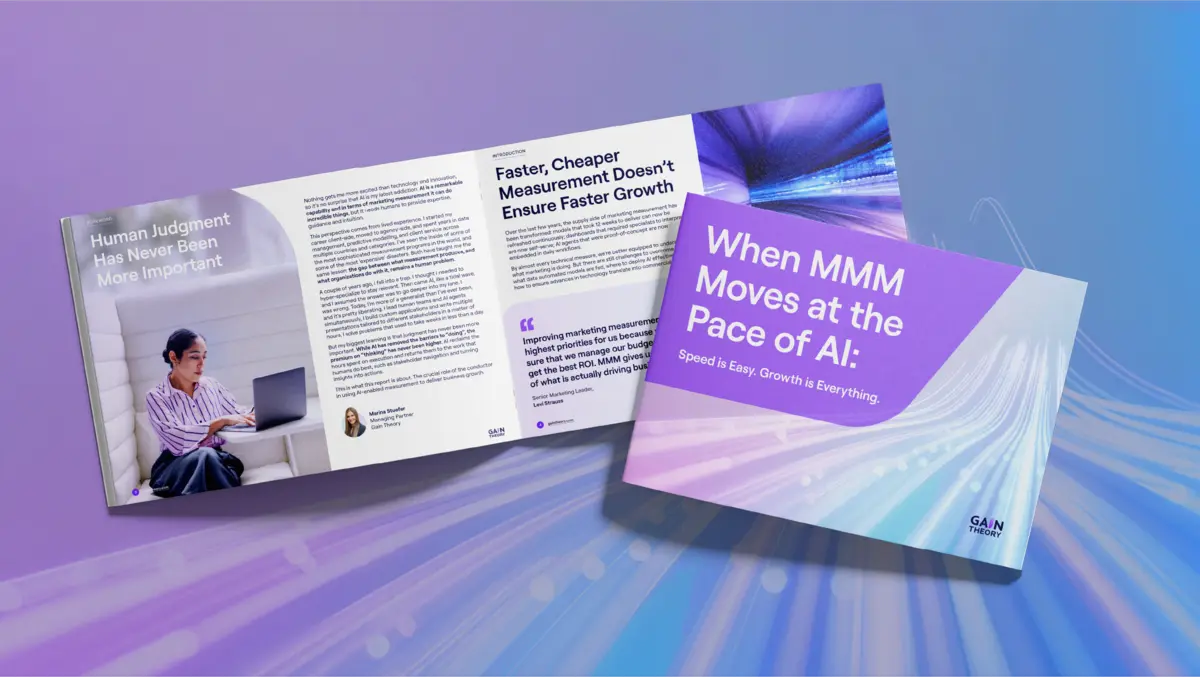
Gain Theory has published a global study on AI in marketing measurement, finding that only 3% of senior marketers believe their organisations are fully ready to deploy AI in this area.
The study surveyed 103 Senior Marketing Leaders across large brands including The Coca-Cola Company, Expedia Group, Novartis, P&G and Walmart. Together, those respondents oversee more than USD $100 billion in marketing spend.
The findings point to a gap between the speed AI brings to marketing mix modelling, or MMM, and companies' ability to turn that speed into decisions and commercial results. Nearly two-thirds of respondents, or 62%, said AI-driven speed had improved decision-making more than any other MMM advance in the past two years.
Even so, 58% reported a gap between the insights generated by measurement and the decisions their organisations actually acted on. Another 68% said acting on measurement insights is not formally mandated within their organisation.
Trust gap
The report suggests the problem extends beyond marketing teams. Almost three-quarters of respondents, or 73%, said their Chief Financial Officer does not fully trust or use marketing measurement outputs.
The figure was lower in North America, at 66%, than in the rest of the world, where it rose to 82%. This regional split suggests confidence in measurement remains uneven across global businesses, even as AI tools become more widely used.
Data quality also emerged as a central obstacle. More than half of respondents, or 55%, said analysts spend at least 30% of their time reworking incomplete or incorrect data, equivalent to roughly a day and a half each week.
Another 43% said they had low or limited confidence in their ability to track the exact return on investment of media spending across all channels. The findings suggest faster systems are not resolving longstanding issues around data quality and accountability.
Karen Kaufman, Global Chief Growth Officer at Gain Theory, said the broader challenge is organisational rather than purely technical. "AI is transforming MMM, but technology alone won't turn insight into growth. The real advantage comes from combining AI with human judgment, experience and accountability to build trust in measurement and move organizations from insight to action. As AI takes on more of the execution, those human capabilities become more valuable, not less," Kaufman said.
Skills pressure
The research also highlighted a shortage of internal skills linked to AI oversight. More than half of respondents, or 54%, identified algorithmic oversight as the most critical skills gap in their teams.
Looking ahead, 46% said AI orchestration is the skill most likely to deliver the greatest value over the next two years. The report argues that marketers will need people who can assess AI-generated outputs, explain them to senior stakeholders and ensure recommendations are carried through.
Thomas Barta, Marketing Leadership & Growth Expert, said better systems alone would not improve results. "AI is making marketing measurement faster, cheaper, and more accessible, but better models don't automatically lead to better decisions. To turn insights into commercial outcomes, you need to focus on human dynamics," Barta said.
This shift is creating demand for what Gain Theory describes as a multidisciplinary orchestrator: a marketer who can combine commercial judgement with oversight of AI outputs and internal decision-making processes. The report links that role to the need to bridge gaps between analysts, marketers and finance leaders.
Delivery models
The study also examined how brands are organising their MMM work. A hybrid approach, combining technology with outside expertise, was the most common model, used by 52% of respondents.
By comparison, 29% said they use software-as-a-service or in-house models, while 18% rely on a consultancy-led approach. This distribution suggests many large companies are not choosing fully internal or fully outsourced measurement structures.
The sample included respondents in North America, EMEA, Asia-Pacific, Latin America, and global or multi-region roles, spanning sectors such as healthcare and pharmaceuticals, consumer goods, technology, retail and financial services. Respondents included Chief Marketing Officers as well as senior executives in marketing, analytics, data science and insight functions.
Overall, the findings indicate that AI adoption in marketing measurement is moving faster than changes to internal governance, data management and decision-making. Despite wider use of AI tools, only a small minority of marketers surveyed said their organisation's infrastructure, compliance and team skills are fully optimised to deploy AI in marketing measurement today.