

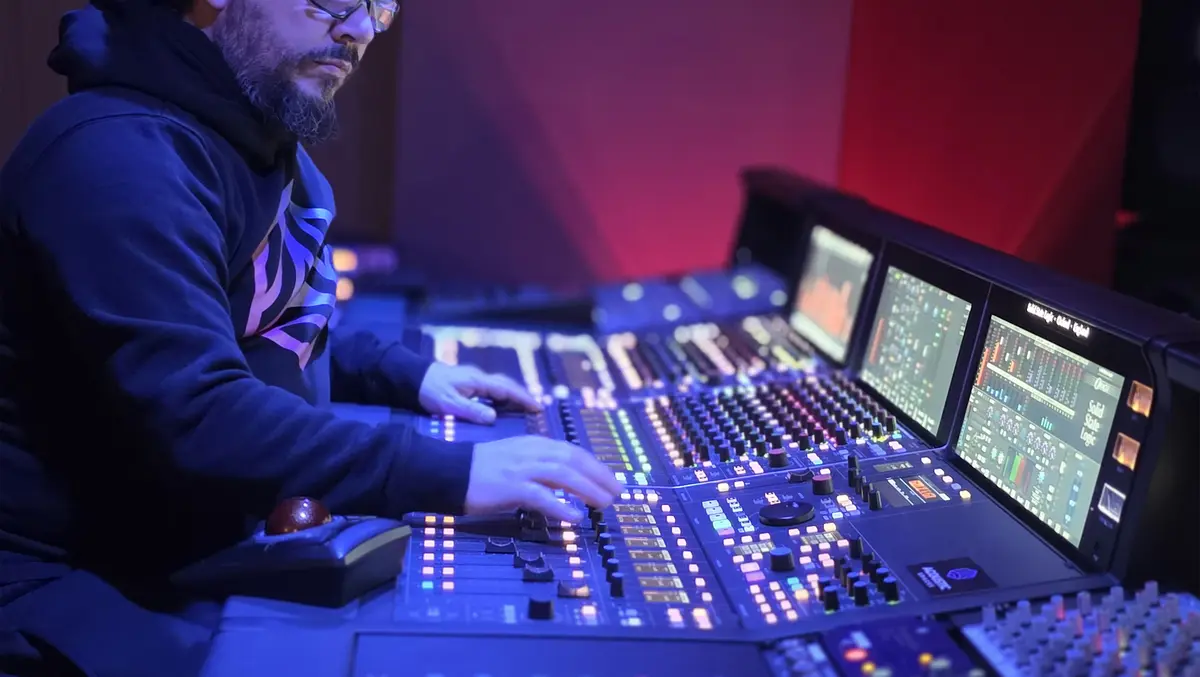
Dennis Busch installs SSL Oracle in new German studio
Tue, 24th Nov 2026 (Today)
Dennis Busch has installed a Solid State Logic Oracle 24-channel mixing console at his new Acoustic Spaces studio complex in Germany, which combines his personal production work with commercial studio services.
Busch is a studio designer, acoustician, engineer and musician, and Chief Executive Officer of Acoustic Spaces and monitor manufacturer Sky-Audio. The new facility is part of a residential complex and is intended to support production, mixing and mastering across multiple rooms, with plans for a Dolby Atmos mix room and a mastering suite within the wider development.
At the centre of the operation is Solid State Logic's Oracle console. Busch said the choice reflected both his long-standing use of SSL equipment and his preference for an analogue workflow with faster recall than older systems offered.
"I'm a long-time fan of SSL," said Dennis Busch, Chief Executive Officer of Acoustic Spaces. "I was the guy recording the bands I was in and got my diploma as a recording engineer at a recording school. Since then, I've been a big fan of SSL, because SSL is so reliable."
Before moving to Oracle, Busch had used an SSL AWS 948 48-channel analogue console for several years. He said older recall methods could slow down work because some settings still had to be adjusted by hand after loading a session.
Workflow shift
Oracle is built around a fully analogue signal path with an Instant Recall system that can reset console functions. Busch said that, in a studio handling multiple sessions a day, the feature significantly speeds up changeovers between projects.
"Recalling a project on an AWS was time consuming, because you could recall the soft buttons but then you had to manually turn the EQs," Busch said.
He contrasted that with a typical day in which a morning recording session could be followed by a separate mix session later on, with the desk reset in less time than it takes to load a digital audio workstation session. He also said the choice was driven by sound quality as much as workflow.
"Plus, it's all analogue," Busch said. "The sound quality is just superb. I don't feel that any DAW can come close to analogue summing."
Busch also highlighted the desk's onboard processing during mix work. He described using the console compressor and dynamic EQ while finishing a progressive metal project, saying the tools helped resolve issues he had not been able to settle beforehand.
"I thought, 'Why doesn't it move together?' So I used THE BUS+ Console Compressor and - okay, there it is, it's ready, and I sent it to the band. The onboard analogue dynamic EQ is extremely useful for both corrective and creative work. I often use Oracle's four mix busses to do parallel compression on drums, parallel compression on the mix, and so on," Busch said.
Software update
Busch completed the room as SSL released its O-Series V2.0 software update for Oracle. The update adds functions for session compatibility, automation and recall management, which Busch said expanded the console's day-to-day capabilities.
He pointed in particular to the level of automation available across large and small faders, mutes, VCAs, stereo groups and stereo buses. He said the automation system and physical control layout made the desk easier to navigate during complex mixes.
"It was a very emotional moment for me to get into this automation," Busch said, "because you have automation for the input channel large fader and the small fader, and on both pathways you have automated mutes. You also have 24 VCAs, and you can group the VCAs, and they are automatable, which is awesome. Then you have the stereo groups, and even they are automatable, and you have four stereo buses, and you can automate those, too. And you can automate the EQ and 10 aux sends on and off, and drop 16 track busses on top! It's crazy! I love how smooth the fader moves are. I'm really in love with this console."
Busch said he commonly routes drums into the desk from channel one onward, splitting sources between long and small faders, such as placing the snare top microphone on the long fader and the snare bottom on the small fader. He said SSL's O-Motion plug-in-based automation system lets him address those faders together while switching between banks on the console surface.
"I have O-Motion plug-ins across all the channel I wish to automate. Then on the first bay of the console, I have the large fader inputs on channels one through eight, and on the second bay I have access to the small faders. The workflow is intuitive, you almost instantly start spilling out or bank across channels using the controls on the tile. Oracle makes mixing become very fast and fluid," Busch said.
Room design
Snapshot recall is another feature Busch highlighted, especially for repeated song sections. He said it can store a completed chorus, for example, and restore that state later in the session without rebuilding the settings manually.
"Let's say I have built up a chorus which is perfectly fine. I can do a snapshot of that, work through the song and, when the next chorus hits, I can just reload the snapshot. It is super powerful, whether it's recalling mixes or allowing me to explore creatively," Busch said.
The installation also reflects Busch's work as an acoustician and studio builder. Oracle sits in custom furniture that matches the desk's profile and includes 19-inch rack bays on either side, alongside integrated SSL and outboard equipment. Busch said the console's hardware layout offers practical advantages in room design because it avoids the large reflective surfaces found in some older desks and allows external analogue racks to be placed either inside or outside the control room.
"I think SSL was genius in designing this with external analogue racks," Busch said.
He said that flexibility matters when building control rooms with limited treatment options or narrow listening positions. "You can put the console racks in or outside of the control room. There really is a new level of flexibility both acoustically and integration-wise, when designing rooms around SSL's future analogue consoles," Busch said.
For Busch, the result is a console choice tied as much to acoustics and room planning as to mixing. "If you have a very difficult room that you maybe can't treat as perfectly as you would like, or you have a tight sweet spot, with this console, it's not a problem. My personal opinion? I think that Oracle is the future of console design and that Odyssey its master," Busch said.