

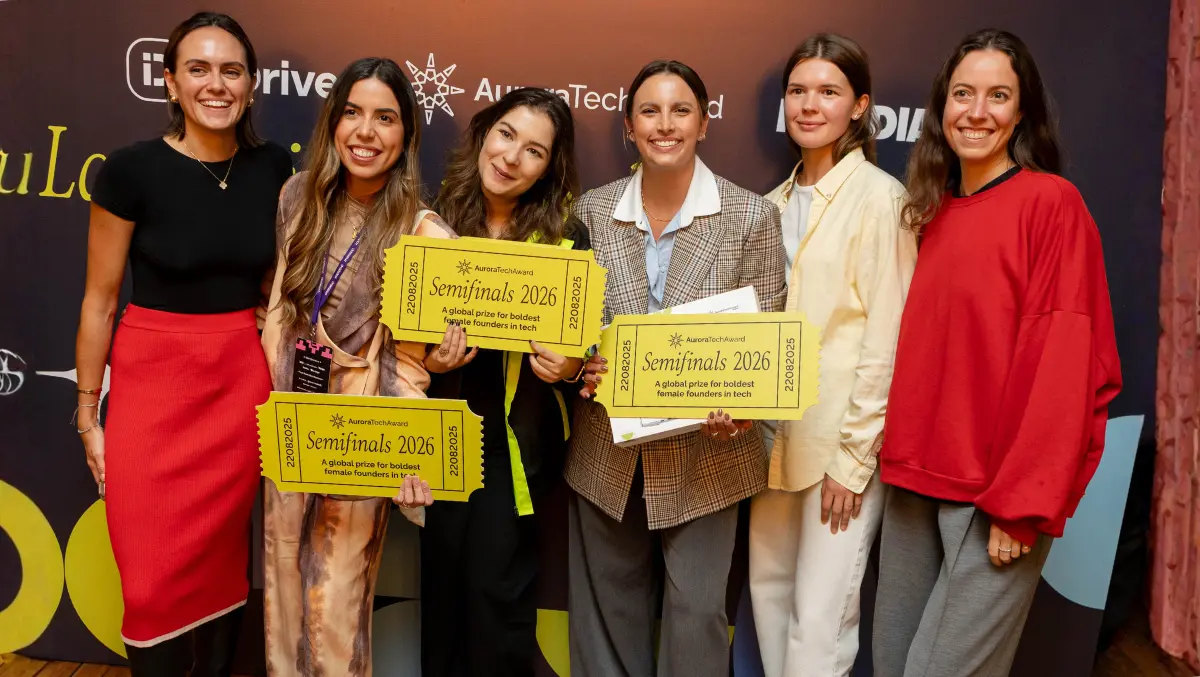
Aurora Tech backs 10 women-led startups in emerging markets
Tue, 24th Feb 2026.webp)
Aurora Tech Award has named 10 women-led startups from emerging markets as finalists in its latest cohort, after reviewing 3,400 applications from 127 countries. More than 40 venture capital firms took part in the selection panel.
The finalists will pitch in Santiago for non-dilutive funding and introductions to Aurora's investor network. The programme focuses on pre-seed and seed-stage companies in AI, fintech, healthtech, agritech and sustainability.
The announcement comes amid persistent gaps in venture capital funding for women founders. All-women founding teams account for 5.6% of global VC deals but receive 1.4% of total funding, according to figures cited by the organisers. These companies represent 6.2% of global VC exit value.
Investor-led process
Aurora's partner network includes DPI Venture Capital, Ventures Platform, Janngo Capital, Sarmayacar Ventures, SuperSeed, Imagine Ventures and Plus VC. Investors reviewed applications aligned with their sector and regional expertise, combining investor scoring with the programme's internal benchmarks.
Isabella Ghassemi-Smith, Head of the Aurora Tech Award, said Aurora aimed to create a pipeline that investors could engage with.
"Aurora's purpose is to make sure exceptional women founders who are already demonstrating traction in emerging markets get the visibility, the access to investors and the capital they deserve. We've created a rigorous selection process that ensures our finalists are investor-approved, capital-ready, and primed to disrupt their industries with bold new thinking. This top 10 sends a clear signal to the market: these are the founders you should be watching."
Javier Cueto, Managing Partner at Imagine Ventures, said the programme grew in Latin America this year, with eight of the selected startups based in the region.
"This year has shown how much the Aurora Tech Award has grown, particularly in LATAM, where eight of this year's cohort are based. Not only were there more applications, but there was a clear step-change in the quality of these businesses. This top 10 is proof that you don't have to choose between impact and returns - these founders are building commercial businesses to solve real, local problems across a diverse range of industries."
Top 10 finalists
Famasi, founded by Adeola Ayoola in Nigeria, targets pharmacy operations and inventory visibility across networks. It routes prescriptions to nearby pharmacies where medicines are available.
From Panama, Adriana Gonzalez's tizo uses AI-enabled messaging for commerce across local store networks. It targets unbanked shoppers and small merchants in Latin America.
Morado, led by Angela Acosta in Colombia, provides credit and working capital for women in the beauty sector. It uses AI models for underwriting.
Another Colombia-based startup, Innmetec, led by Catalina Isaza, works in medtech. It provides personalised surgical implants and pre-surgery planning tools using 3D printing and biomaterials.
Estefanía Abello's Muta, also in Colombia, addresses recycling supply chains. The platform digitises processes and adds traceability for compliance and verification of materials' origins and sustainability metrics.
In Chile, Maria Kawas's DomestikCo offers HR software for households that employ domestic workers. The product automates employment contracts, payroll and compliance.
Brazil-based OncoAI, founded by Mariana Zuliani, provides AI-driven clinical insights for oncology. The company says its product helps predict cancer recurrence and inform treatment decisions.
Quipu, led by Mercedes Bidart in Colombia, is developing an alternative credit scoring system for informal workers. The firm positions it as a route to fairer access to capital for borrowers without traditional credit histories.
In Mexico, Patricia Florencia's Pilou is an AI-driven wealthtech business. It targets Latin American consumers, with a stated focus on women, and aims to simplify investment account management and decision-making.
Kenyan startup Pesira Technologies, founded by Penny Musengi, operates in agritech. The platform connects farmers, agribusinesses and finance providers, with a focus on financial services and market access.
Programme scope
Aurora Tech Award is powered by inDrive, a mobility and urban services platform. inDrive also runs New Ventures, its venture and M&A arm, and operates across 48 countries.
The award is open to women-founded tech startups that have been operating for five years or less, with a product or functional prototype and less than USD $6 million in total funding.
The organisers pointed to recent alumni performance to illustrate outcomes after participation. Nigerian fintech HerVest, which placed first in the 2025 cohort, reported 270% growth in loan disbursements to $284m, 36% year-on-year revenue growth, and more than 150,000 women reached through savings, lending and financial education products. UpLeap, an AI-based medical training platform that placed fifth last year, reported a $330k pre-seed round and growth to more than 1,600 healthcare professionals completing 6,000 training sessions.
The 10 finalists will pitch in Santiago in front of investors and a jury. Winners for the next cycle will be announced after the final presentations.