

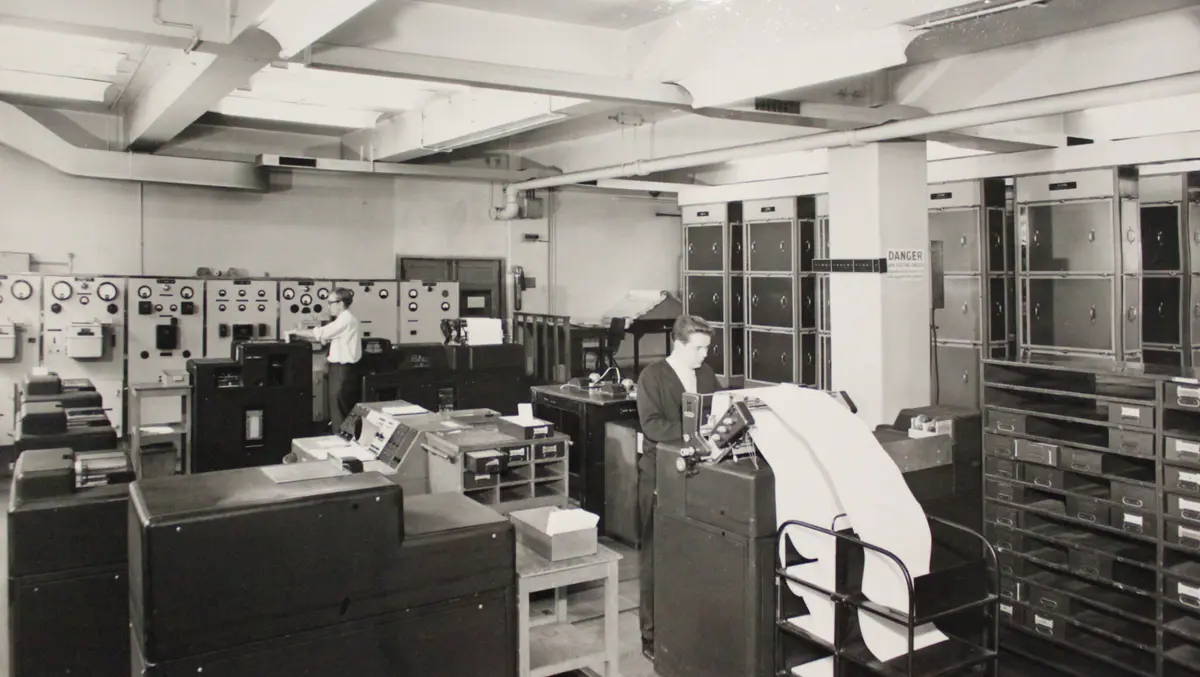

Research from the Leo Computers Society found that most Britons are unfamiliar with LEO, the world's first business computer, as the machine marks its 75th anniversary.
A survey of 2,000 UK adults found that 80% were not familiar with LEO and 65% had never heard of it. Just under half, 46%, correctly identified the UK as the country that built the first business computer.
LEO, short for Lyons Electronic Office, was built by J. Lyons, the catering and teashop company, and completed a three-day operational run in 1951. It is widely recognised as the first computer used for routine business work rather than scientific or military calculation.
Its first task was bakery and stock valuation for the Lyons business, work that had previously taken several days by hand. The Leo Computers Society said the computer completed it in five hours.
The polling suggests the story has only a limited place in public memory. Nearly eight in 10 respondents, 78%, could not name any British computing pioneers, while 74% said they were surprised to learn that Britain, rather than Silicon Valley, was the birthplace of business computing.
When asked what kind of company built the first business computer, respondents were far more likely to assume it was a technology company than a food or retail business. After being told that J. Lyons built LEO, 86% said they were surprised.
Calls for recognition
The findings also point to support for wider official recognition of LEO's place in British industrial and technological history. Some 69% said LEO deserved greater recognition for its contribution to global computing, while 64% said the UK government should do more to raise awareness of its legacy.
There was also support for its inclusion in education. The survey found that 71% agreed LEO should be part of the national curriculum, including 36% who strongly agreed.
Support extended beyond schools, with just over four in 10 respondents saying there should be a National LEO Day.
The research also showed notable gaps in sectors often associated with public history and education. Three-quarters of respondents working in government and education said they had never heard of LEO.
Age patterns were mixed. The survey found that 96% of boomers were not familiar with LEO, compared with 60% of Gen Z, yet boomers were also more likely than some younger groups to name a British computing pioneer.
Among those who could name one, Alan Turing was mentioned most often, followed by Sir Alan Sugar or Amstrad, Charles Babbage, IBM and Clive Sinclair. More than half of respondents said education focused too heavily on figures such as Turing at the expense of achievements such as LEO.
Business roots
LEO grew out of the post-war operations of J. Lyons, which ran a large national business including teashops, bakeries, hotels and catering contracts. At its peak, the company employed more than 30,000 people and used the computer project to find more efficient ways to manage stock and other routine administrative work.
That remains one of the most unexpected parts of the story for the public. Nearly half of respondents said they were very surprised to learn that a high street bakery and tea shop played a significant role in the development of modern business computing.
Hilary Caminer, daughter of LEO I pioneer David Caminer and a member of the Leo Computers Society, said: "My father and all the people who worked on LEO were true British pioneers. They built the machine and invented systems and design processes from scratch. Now that everyone has access to immense computer power in their own hands, it's amazing to see just how much floor space LEO took up, how many valves it used, how its memory had to be constructed from long, expensive and heavy mercury tubes, and how little memory capacity it had. Yet what it achieved in revolutionising essential business processes is pivotal to today's modern business computing world."
Gloria Guy, who worked on LEO I in 1954, described the shift from manual administration to automated processing.
"It is impossible to overstate the importance of what J. Lyons & Co. did in November 1951. At that time, none of LEO's operating staff had actual titles, because it was all so new, but these days I would be called a data entry clerk. I punched out the binary tape that, after being checked and scrutinised, was eventually fed into a machine on LEO. I remember the punch card machines booming loudly and quickly, and I was very aware of the computers working in the computer room because of these sounds. Even though I joined LEO in 1954, it's vital we recognise that before that day in 1951, every organisation of any size in the world employed teams of clerks to carry out basic business tasks such as order processing, invoicing, stock control and payroll by hand. After LEO showed the way, the rest of the world followed, and companies like Ocado have applied those systems in their logistics today. LEO did it first, leading to a huge leap forward in business productivity worldwide and to the computerised accounting and ERP systems that we take for granted today," Guy said.
Peter Byford, chairman of the Leo Computers Society, said: "I am repeatedly struck by how astonished people are to learn that the world's first business computer was designed and built by a catering company, J. Lyons & Co. It's worrying that most respondents remain completely unaware of LEO and the pioneers who created the world's first business computer. Many assume it was America. Yet LEO not only delivered the first commercial computing system, it also introduced systems analysis and design to the world stage. It's encouraging that people want the government and education system to recognise the British pioneers and legacy of LEO with a National LEO Day. Maybe this could serve as the starting point for a broader British Innovation Day, one that celebrates LEO alongside other significant British achievements, many of which have faded from public memory, often overshadowed by the scale and resources of American industry. Expanding our educational reach would be an important step in ensuring that LEO's legacy is properly understood and appreciated."