

UK marketers worry current data strategies may not last
Thu, 5th Nov 2026
Blis has published research showing widespread concern among UK marketing leaders about the durability of their current data strategies. It found that 95% of those surveyed were significantly concerned about how long those approaches would remain viable.
The findings are based on a survey of 200 senior UK marketing decision-makers conducted by Sapio Research, alongside campaign tests by Blis across five audience segments. The study points to growing unease in digital advertising as cookie-free web traffic increases and marketers question the quality of the data feeding audience-targeting tools.
More than four in five respondents, or 82%, said a lookalike or expanded audience is only as good as its seed data. Data quality emerged as a central issue, with 78% saying source data quality directly affects campaign performance.
Accuracy was the biggest audience-targeting obstacle for 59% of respondents, ahead of cross-platform consistency at 45% and signal loss or user privacy challenges at 39%. Almost seven in 10, or 69%, said single-channel and siloed data sources create a fragmented and insufficient view of the customer journey.
Less than half of those surveyed, 48%, were confident that their existing audience inputs met their standards for accuracy. That suggests many marketing teams continue to spend on digital campaigns while questioning the reliability of the data behind them.
Telco testing
Blis also used the study to argue that telecommunications data could provide an alternative signal for audience targeting in a market less reliant on cookies and device identifiers. Among respondents, 82% agreed telco data had the potential to become an essential signal for future omnichannel targeting, while 59% identified accuracy and quality as its main benefits.
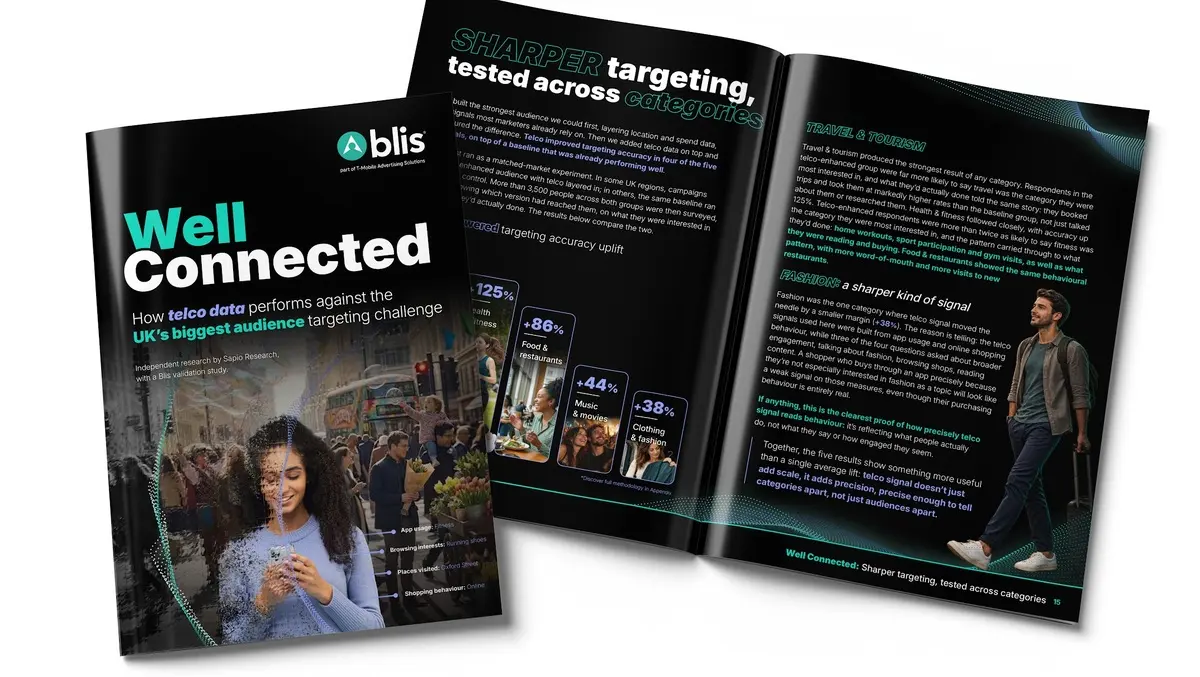
To support that case, Blis ran side-by-side campaign tests across Travel & Tourism, Health & Fitness, Food & Restaurants, Music & Movies, and Clothing & Fashion. A control group using standard campaign targeting was compared with one that added telco-verified data signals to the targeting criteria.
Each category recorded a statistically significant increase in category affinity ranging from 38% to 155%, according to Blis. The test covered more than 3,500 respondents in selected UK geographies and used a 95% confidence threshold.
The methodology described a baseline audience in each vertical built using location and spend signals combined with Experian consumer segments and spend data. Matched geographic areas then received an extra layer of telco signal, while control areas kept the baseline data stack.
Participants were asked four questions covering category interest, most-engaged category, actions taken in the last month, and actions expected in the next three months. Results were then compared between the control and telco-enhanced groups for each vertical.
Market pressure
The research adds to a broader debate in digital advertising over how marketers should adapt as third-party cookies decline and privacy rules tighten. Advertisers have been testing a range of alternatives, including first-party data, contextual targeting, clean rooms, and identity-based systems, but the survey suggests many remain unconvinced that current substitutes can fully address signal loss.
For companies selling data-driven advertising tools, that creates an opening to position network-derived signals as a more durable option. Blis said its telco data is based on signals such as app usage and movement patterns drawn from mobile networks rather than cookies or device IDs.
Blis, which is part of T-Mobile Advertising Solutions, said its UK telco partnerships provide access to networks reaching up to 99% of the UK population with 4G coverage, alongside an estimated 78 million UK mobile connections. It added that around 53 million of those connections are available exclusively through Blis within the advertising and marketing industry.
Charlie Smith, Chief Revenue Officer at Blis, said the findings reflected growing strain on confidence in established approaches to digital targeting. "Data accuracy is not optional in the evolving digital landscape. This research makes it clear: signal loss is a significant and urgent issue for many of the UK's most influential marketers. The vast majority are very aware that traditional data sources just aren't fit for modern marketing purposes. As modeling and automation play ever greater roles within digital, they can only ever be as good as their foundational seed data. The opportunity presented by trusted telco data, especially provided through an omnichannel DSP like us, is simultaneously reliable, privacy-first, and highly actionable. This study demonstrates it can deliver exceptional precision and, crucially, outcomes," Smith said.