Skills shortage stories
BenchBee says UK IT consultancies waste GBP £3.06bn a year on idle staff, urging a shared-talent model inspired by government reforms.
UK leaders now see AI and automation as top drivers of resilience, yet most still define it mainly as cyber security, new research finds.
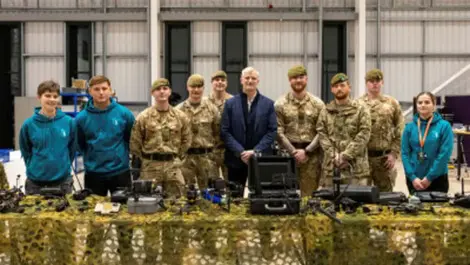
NMITE and the British Army have unveiled a three-year autonomous robotics MEng, blending drone technology with hands-on defence-linked projects.
Only 1% of FTSE AIM-100 firms have AI embedded in core operations, as poor data governance and weak strategy stall wider adoption.
NMITE launches a three-year autonomous robotics MEng from 2026, tying drones, defence needs and local industry into a hands-on curriculum.
UK bosses are ramping up AI spend, but PwC finds only a sliver are turning pilots into scaled value amid talent and bureaucracy hurdles.
UK health and beauty marketers plan to deepen AI use in 2026 while boosting hiring, creative budgets and influencer partnerships.
SonicWall launches unified automation tools to cut alert fatigue, speed cyber threat remediation and streamline overstretched security teams.
Accountants double down on everyday AI tools, as optimism stays high but scepticism, job fears and data security worries all intensify.
AI is exposing the limits of aging campus and branch networks, pushing enterprises and MSPs towards unified, cloud-managed, secure platforms.
New global survey warns a widening 'complexity gap' leaves AI-driven, multi-cloud environments outpacing organisations' security defences.
Skillsoft has appointed Bernard Barbour as Chief Technology and Product Officer to drive AI-led evolution of its Percipio skills platform.
KPMG warns firms' AI ambitions outpace delivery, with most chasing top maturity by 2026 but only a quarter scaling agentic AI with ROI.
CrowdStrike cites a Forrester study claiming 273% ROI and USD $5m in three-year benefits from consolidating legacy endpoint security.
Legacy PKI and manual certificate management leave APAC firms exposed to outages, cyber risks and compliance failures, CyberArk warns.
AI-fuelled cloud adoption is outpacing security teams, with Fortinet warning a widening 'complexity gap' leaves hybrid estates exposed.
FloQast surpasses $200m ARR and strikes EY AI alliance as it targets enterprise finance transformation and global expansion.
BMC injects generative AI into Control-M and AMI, adding NLP workflow design, event-driven orchestration and embedded mainframe guidance.
Commonwealth Bank teams with OpenAI on AI and cyber training to close skills gaps for 1 million Australian small business customers.
Australian Spatial Analytics has created over 230 data careers for young neurodivergent adults while delivering AUD $18 million in projects.