

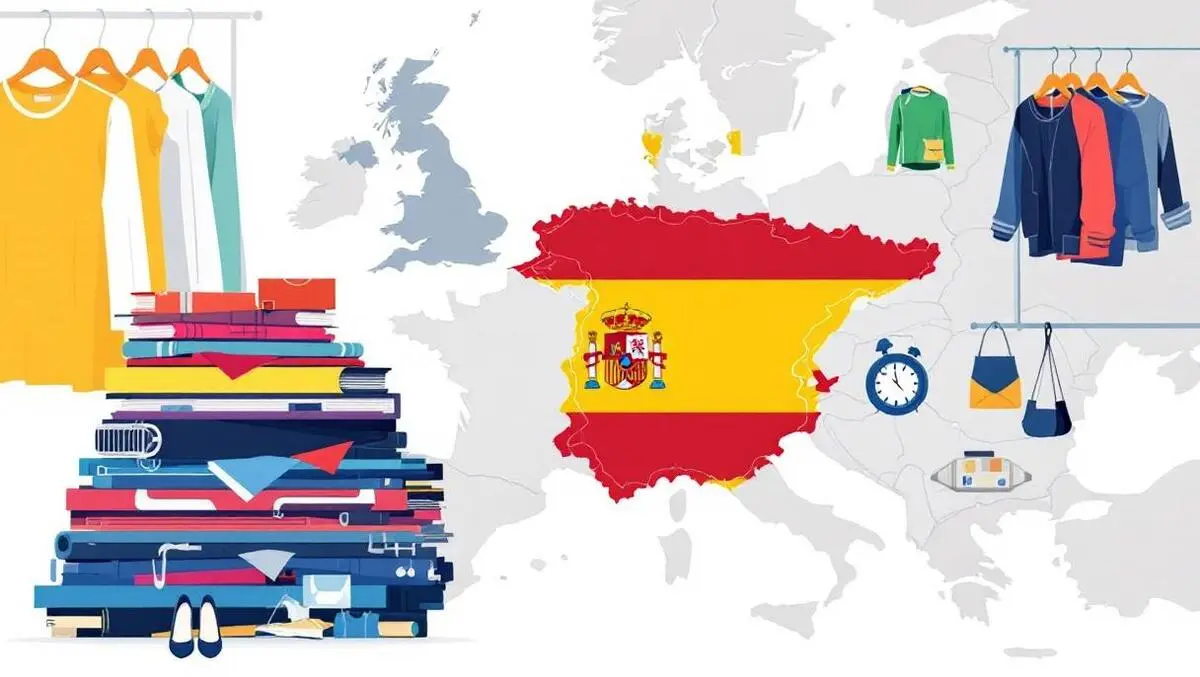
Spain tops global fast fashion charts as Europe dominates market
Wed, 23rd Jul 2025
Spain leads global rankings in fast fashion market dominance, with 91.5% of its clothing sector controlled by retailers in this category, according to newly published research by Kaiia.
The study examined the fast fashion industry's presence across multiple countries, assessing factors such as market revenue split, per-capita search volume for fast fashion, and the percentage of fast fashion within national clothing markets. Spain, followed by the United Kingdom, Belgium, Germany, and France, occupy the top five positions.
European dominance
European markets heavily feature in the top positions for fast fashion's influence. Of the top ten, all but one are European, with India the sole non-European entry. The research found that in Spain, shoppers allocate EUR €27.4 billion of a EUR €29.96 billion total clothing budget to fast fashion, leaving just 8.5% for traditional garment retailers.
The United Kingdom places second, with 88.5% of clothing purchases made from fast fashion outlets. British consumers spend EUR €73.38 billion out of a total EUR €82.89 billion clothing expenditure on this sector, making the UK Europe's highest-value fast fashion market by overall revenue.
Belgium takes the third spot, with 86.1% of its EUR €10.46 billion clothing market belonging to fast fashion. This translates to EUR €9.01 billion in fast fashion sales, suggesting minimal market opportunity for traditional retailers.
Germany and France follow, with 85.1% and 84.1% of their national clothing markets, respectively, attributed to fast fashion. In Germany, this amounts to EUR €61.76 billion out of EUR €72.57 billion in clothing revenue. In contrast, in France, EUR €33.65 billion of the EUR €40.02 billion clothing budget is allocated to fast fashion retailers.
Online attention and brand interest
The study highlighted a notable trend in online shopping behaviour: Shein, a fast fashion retailer, generated more online interest than both Zara and H&M combined across surveyed countries.
In Spain, this interest in Shein even surpasses that of local brands such as Zara, despite Zara being founded in the country. A similar pattern is observed in Belgium, where "Shein" is a preferred search term among online shoppers. Conversely, in the Netherlands, Scandinavian brand H&M holds the most interest, while Polish consumers distribute attention more evenly across different fast fashion outlets.
Market sizes and proportions
Austria ranks sixth with 83.1% of its clothing market classed as fast fashion, equating to EUR €8.88 billion in revenue. Traditional clothing sales account for just 17% of Austrian clothing spend at EUR €1.8 billion. Poland and the Netherlands follow closely, both with fast fashion representing about 75% of total spend (EUR €12.29 billion out of EUR €16.44 billion in Poland, and EUR €15.62 billion out of EUR €20.90 billion in the Netherlands).
Turkey, at ninth, holds just under 70% of the fast fashion market share (EUR €12.78 billion in a total clothing market of EUR €18.27 billion). India rounds out the top ten. Here, fast fashion commands a 49.3% market share – a proportionally lower share due to the market's large size and the persistence of traditional textiles, but still amounts to EUR €50 billion in annual revenue.
Contrasts in consumer behaviour
"The results show fast fashion has completely taken over in Europe," says the Kaiia spokesperson. "Spain's 91% market share proves how dominant these retailers have become. Most European countries now spend the majority of their clothing budgets on fast fashion rather than traditional retailers. What's particularly surprising is the contradiction between Europe's strong sustainability advocacy and actual consumer behavior - despite widespread environmental awareness campaigns, Europeans are clearly not willing to follow through when it comes to their clothing choices."
The global fast fashion industry is valued at over USD $100 billion annually, according to the study, with Europe accounting for the bulk of revenue and share across the leading markets.
The analysis was based on multiple factors, including per-capita online searches, total and segment-specific market revenue, and the proportion of fast fashion brands in national clothing markets.
Shein's prominence in search interest, exceeding that of both Zara and H&M combined in each surveyed country, was noted as a significant finding, particularly given its distance from European origins. This suggests ongoing shifts in brand loyalty and digital engagement patterns among consumers.
The results underline that fast fashion retailers maintain a substantial market share in Europe, with consumer demand continuing to drive growth despite sustainability campaigns and ongoing discussions regarding environmental impact.