

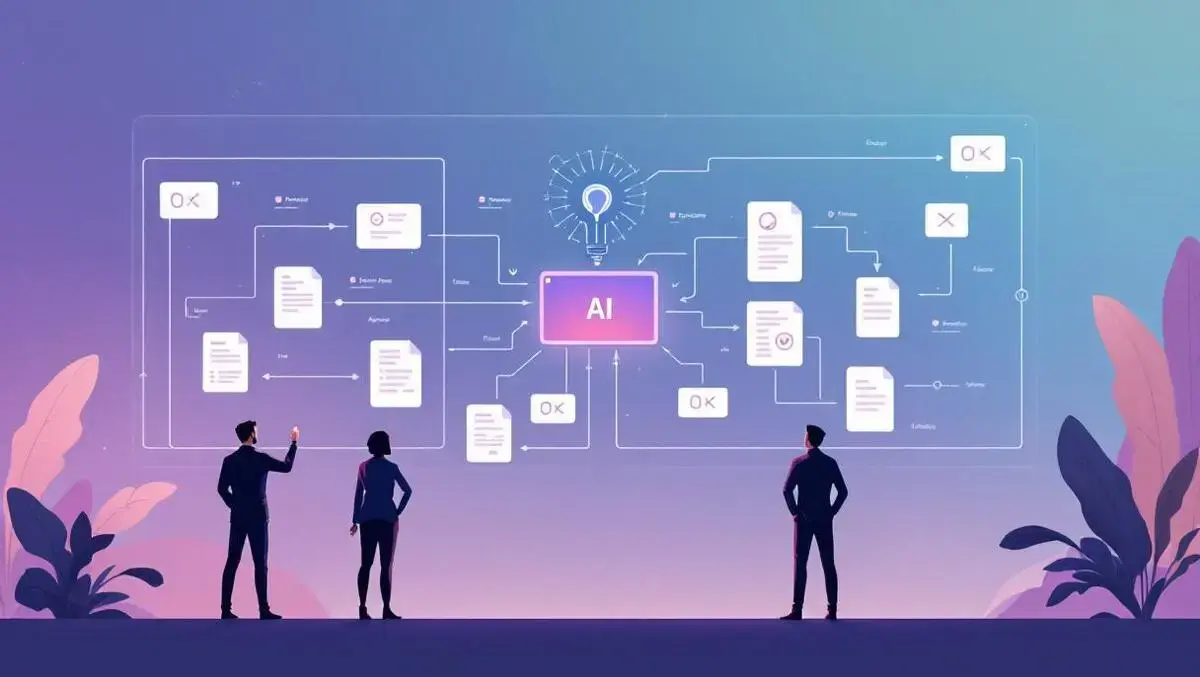
Why the next phase of AI in business will be about workflow control, not just generation
Thu, 21st May 2026
For the past two years, much of the public conversation around artificial intelligence in business has focused on generation. Can a model write an email, summarise a meeting, draft a proposal, or produce content quickly enough to save time? Those questions were natural at the start of the cycle. Generation is visible. It is easy to demonstrate, easy to market, and easy to understand. But for businesses trying to apply AI inside real commercial operations, generation is no longer the most important issue.
The more consequential question is now one of workflow control. Once AI becomes part of everyday business activity, organisations have to decide how that activity is managed, reviewed, governed and connected to the rest of the process. A useful draft generated in seconds is only one small part of the picture. The wider challenge is making sure that the right people see it, that it fits the right context, that it moves through the right approvals, and that it sits inside a process that remains coherent rather than chaotic.
This is especially true in customer-facing work. Sales, marketing and business development teams often operate under pressure, with limited time and rising expectations. AI can clearly help with speed, but speed on its own does not solve fragmentation. In many organisations, lead handling, message drafting, campaign planning, inbox activity and reporting still happen across multiple disconnected tools. Adding another AI interface into that mix may improve output in one moment, while making the overall workflow harder to supervise.
That is why the next phase of AI adoption in business will be less about isolated prompts and more about structured operational environments. The businesses that gain the most from AI will not necessarily be the ones using the most tools. They will be the ones that create better discipline around how AI is embedded into day-to-day work. In practice, that means stronger review points, clearer ownership, better visibility over activity, and less dependency on manual workarounds between systems.
There is also a trust issue at stake. Senior decision-makers are becoming more comfortable with AI as a productivity aid, but many remain wary of using it in outward-facing activity without safeguards. That caution is understandable. If AI is being used to support prospecting, communication or relationship management, then businesses need confidence that quality is being maintained and that outputs are being handled in context. Governance, in this sense, is not bureaucracy. It is what makes AI usable at scale.
Smaller businesses may feel this shift most sharply. They often face the greatest pressure to work efficiently, but they do not always have the luxury of adding headcount or investing in large enterprise systems. For them, the attraction of AI is practical rather than experimental: reduce repetitive manual work, improve consistency, and give commercial teams more time to focus on judgement and decision-making. Yet these businesses also have the least room for disorder. If AI introduces more fragmentation rather than less, the value quickly erodes.
This is why software in the coming period is likely to be judged less by how impressively it generates and more by how well it helps businesses run a process. The novelty stage is passing. What matters now is whether AI can sit inside operational infrastructure in a way that is structured, accountable and commercially realistic. Businesses do not need endless point solutions that produce text in isolation. They need systems that help them manage activity more cleanly from one step to the next.
In that sense, the market is beginning to mature. The conversation is moving away from whether AI can assist with work, and towards what kind of working environment it creates. For technology providers, that raises the bar. For buyers, it provides a more useful test. The question is no longer simply, what can this tool generate? It is, what kind of workflow does this enable, and how much better control does it give the business over the work that matters?